
How to Teach Drop It Without a Chase
A sock disappears around the corner. Your dog has picked up a chicken bone on a walk. Or your puppy has found something you really do not want chewed. These are the moments when knowing how to teach drop it matters most. The goal is not to win a tug-of-war or force an item out of your dog’s mouth. It is to teach your dog that letting go is safe, worthwhile, and usually leads to something better.
Done properly, “drop it” can prevent a chase through the house, reduce guarding around found objects, and make daily life less stressful. Done poorly, it can teach a dog to run away, swallow faster, or clamp down whenever a person approaches. Calm practice before an emergency gives you a much better chance of a calm response when it counts.
What “Drop It” Should Mean to Your Dog
“Drop it” means release the item currently in your mouth. It is different from “leave it,” which asks the dog not to pick something up in the first place. Both are useful, but they solve different problems.
A reliable drop cue should not mean, “A person is about to take my stuff away forever.” If that is what your dog expects, they have a good reason to avoid you. Instead, teach a simple exchange: releasing an item makes a reward appear, and sometimes the original item comes right back.
That last part matters more than many owners realize. When a safe toy is returned after your dog releases it, your dog learns that cooperation does not always end the fun. This is especially helpful for puppies, retrievers, and dogs that enjoy carrying things.
Before You Teach Drop It, Choose the Right Setup
Start with an item your dog likes but does not become intensely possessive over. A plain toy, low-value chew, or soft tug toy is often a good choice. Do not begin with a stolen steak, a favorite bone, or an object your dog has guarded before.
Have small, high-value treats ready. Soft treats that can be eaten quickly work best because the practice should keep moving. You are not trying to bribe your dog forever. At the beginning, you are building a clear pattern: release item, get paid.
Practice in a quiet room with no pressure and no need to rush. If your dog is already overexcited, tired, or worried about people near their belongings, make the exercise easier. Training should feel predictable, not like a test.
How to Teach Drop It Step by Step
Start with a simple trade
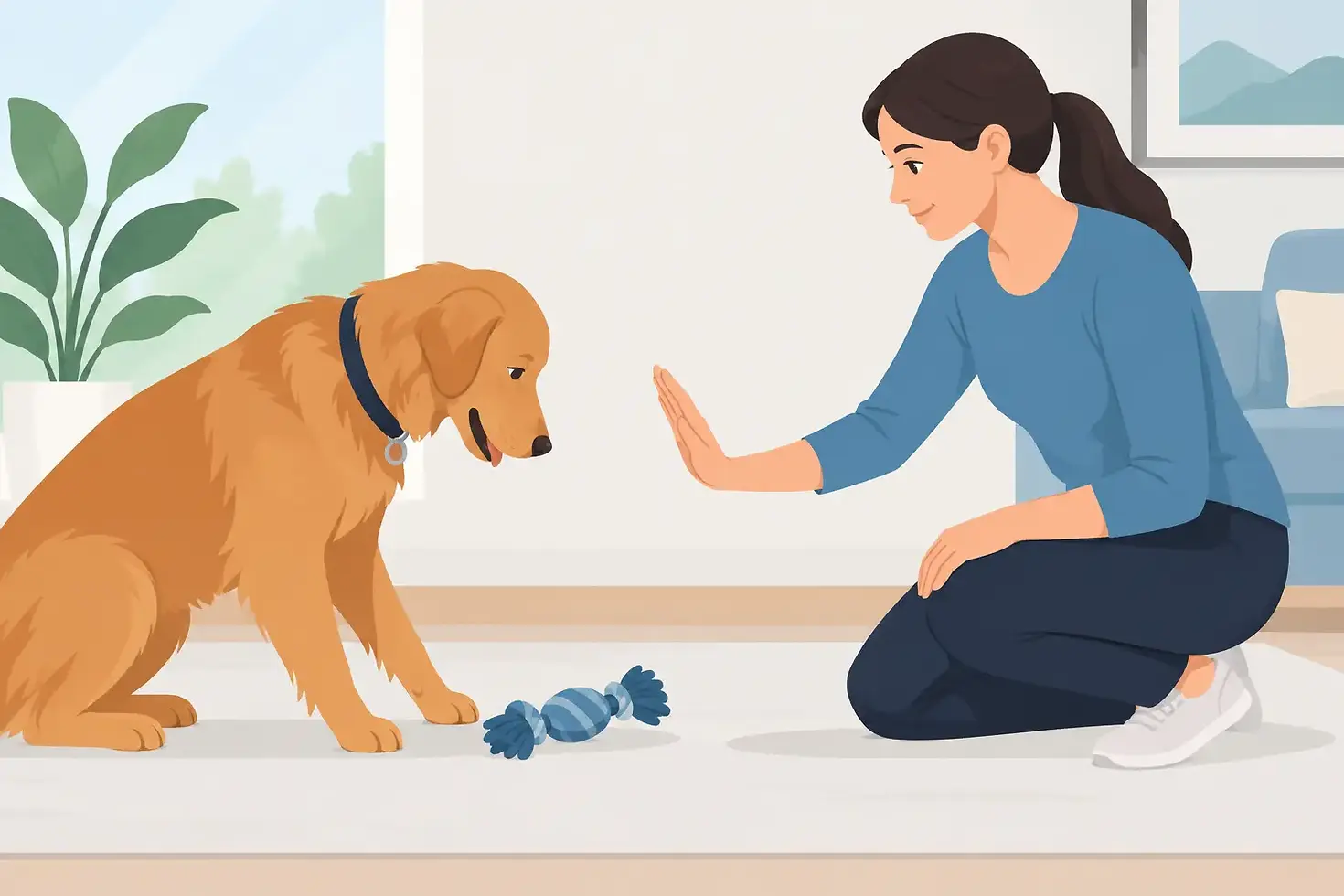
Offer your dog the low-value toy. Let them take it and hold it for a moment. Then place a treat right near their nose. Most dogs will open their mouth to eat the treat. The instant the toy falls, say “drop it” in a calm, clear voice, then give the treat.
At first, the cue may come as your dog is already releasing the toy. That is normal. You are pairing the words with the action. Repeat this several times over short sessions until your dog begins to recognize the pattern.
Do not grab the toy while your dog is eating. Pick it up quietly after they have finished, or let it remain on the floor for a moment. Rushing in to snatch it can make the whole exercise feel less safe.
Say the cue before showing the treat
Once your dog is readily releasing the toy, make a small change. Say “drop it” first, pause for about one second, and then present the treat if needed. When your dog releases, mark the choice with a warm “yes” or “good,” then reward.
Over repetitions, many dogs will start dropping the item as soon as they hear the words, before they see the treat. That is the behavior you want. Keep your delivery matter-of-fact. Repeating “drop it, drop it, drop it” while reaching toward your dog usually makes the cue less meaningful.
Return the toy sometimes
After your dog drops the toy and takes the treat, give the toy back in some repetitions. You can simply offer it again or invite a short game of tug or fetch. This teaches your dog that dropping is not a loss.
You do not need to return every item. In real life, some things must be removed for safety. But returning safe items often enough helps maintain trust and keeps the cue strong.
Gradually raise the difficulty
When the exercise is easy indoors, use a slightly more interesting toy. Practice in another room, then in the yard, then on a calm walk if your dog can still focus. Change only one part of the exercise at a time.
If your dog stops releasing, freezes over the item, or runs away, the step was too difficult. Go back to an easier object or quieter location. That is not failure. It is useful information about what your dog can handle right now.
Avoid Turning It Into a Chase Game
The most common mistake is pursuing a dog who has something forbidden. From the dog’s perspective, this can be exciting play, scary pressure, or both. Either way, the dog may learn to run faster next time.
If your dog has a harmless object, stay calm. Move away rather than toward them, use your practiced cue, and offer a better trade. You can also scatter a few treats at a short distance from the item if your dog is safe to approach and not showing guarding behavior. This gives you time to remove the object without confrontation.
Try not to make a habit of trading for every random sock your dog steals. If socks reliably earn chicken, some dogs become very efficient sock collectors. Prevent access by using laundry baskets, closed doors, and sensible management. Reserve high-value rewards for genuine safety moments or planned training, while still rewarding cooperation in normal practice.
What to Do If Your Dog Guards Items
A dog that stiffens, growls, shows the whites of their eyes, freezes, or snaps when approached around an item is communicating discomfort. Do not punish the growl. A growl is a warning, and removing the warning does not remove the underlying concern.
Do not put your hands in the dog’s mouth, pry the jaws open, or corner the dog to retrieve an item. These actions can lead to a bite and often make guarding worse. If the item is not dangerous, give the dog space and get professional help with a behavior plan.
If the item is dangerous, prioritize human safety. Use distance, barriers, a high-value scatter, or another calm method that does not require physically confronting the dog. The right response depends on the dog, the item, and the immediate risk. A dog that has swallowed something toxic, sharp, or obstructive needs veterinary advice promptly.
Practice for Real Life, Not Perfect Living Room Reps
A dog can understand “drop it” in the kitchen and still struggle when they find a discarded food wrapper outside. That does not mean the training failed. It means real-life distractions are harder.
Build reliability through brief practice woven into ordinary routines. Ask for a drop during toy play. Practice with a leash nearby. Work on it before a walk, after a walk, and in different parts of the home. Keep sessions short enough that your dog stays successful.
For families, make sure everyone uses the same cue. One person saying “drop,” another saying “give,” and someone else shouting “no” can slow learning. Pick one phrase, use it calmly, and make the outcome predictable.
Puppies usually learn quickly, but they also find trouble quickly. Management is part of training, not a substitute for it. Keep tempting objects out of reach while you build the skill. Adult dogs can learn just as well, though a dog with a long history of being chased or having items taken may need slower, more careful work.
When a One-on-One Session Helps
Drop-it training can look simple until it involves a dog that steals food, guards chews, scavenges on walks, or lives with children and other pets. In those cases, generic advice may not fit the household. The best plan should account for what the dog takes, where it happens, who is present, and what the realistic safety concerns are.
CatDog Training works with owners in their own homes and everyday environments, where the actual problem occurs. That allows training to focus on practical handling, household routines, and the exact situations that cause concern, without forcing every dog into the same class format.
Your dog does not need to surrender everything instantly to be making progress. A calm release of an easy toy, repeated consistently, is the foundation. Build that trust now, and the next time your dog finds something they should not have, you are far more likely to get cooperation instead of a chase.


Comments