
How to Stop Puppy Biting Without Harsh Corrections
A puppy who grabs your sleeves, ankles, hands, and pant legs can make a normal evening feel like a wrestling match. The good news is that learning how to stop puppy biting does not require yelling, pinning your puppy down, or using painful corrections. It requires clear boundaries, better ways to play, and a consistent response from every person in the home.
Puppies use their mouths because that is how they explore, play, relieve teething discomfort, and communicate excitement. Biting is normal puppy behavior. What matters is teaching them that human skin and clothing are not part of the game.
Why Puppies Bite So Much
Most puppy biting is not aggression. A young puppy has limited self-control, no hands, and a strong urge to investigate everything with their mouth. They may bite harder when they are tired, overstimulated, hungry, frustrated, or excited by fast-moving feet and children.
Teething also plays a role. Puppies commonly need extra chewing outlets as their adult teeth come in. If they do not have appropriate items to chew, your fingers, furniture, shoelaces, and rug corners become the obvious alternatives.
The pattern can become stronger without anyone meaning to encourage it. Pulling your hand away quickly may trigger chasing. Waving your hands around can look like play. Laughing, squealing, or pushing the puppy away can be exciting attention. From the puppy's point of view, biting worked because it made something fun happen.
How to Stop Puppy Biting in the Moment
When teeth touch skin, stay calm and boring. Do not jerk your hand away or turn it into a chase game. Briefly freeze, then calmly remove your attention. Stand up, turn away, or step behind a baby gate for a short reset. The message is simple: teeth on people make interaction stop.
This only works if the break is immediate and consistent. A puppy cannot connect a consequence that happens minutes later to a bite that is already over. You do not need a long timeout. Ten to 30 seconds is usually enough to interrupt the fun and give everyone a chance to settle.
When you return, offer an appropriate toy before play begins again. If your puppy takes the toy, praise them warmly and continue the interaction. You are not merely stopping an unwanted behavior. You are showing the puppy exactly what to put in their mouth instead.
If the puppy comes straight back for your hands, end the interaction again. Repetition may feel tedious for a few days, but that consistency is what creates a reliable rule. Avoid scolding after the fact or physically holding a puppy's mouth closed. Those methods can create fear, frustration, or more intense struggling without teaching a useful alternative.
Make the Right Choice Easy
A puppy who is expected to stop biting without a replacement behavior is being asked to solve a problem they do not understand. Keep suitable chew toys available where your puppy spends time. Have one in your pocket or near the sofa if biting often starts during family time.
Choose toys that fit your puppy's size and chewing style. Soft toys may work for gentle mouthing, while a sturdy rubber toy may be better for a determined chewer. Supervise any chew item that can break into pieces or become a swallowing risk. Not every popular chew is appropriate for every dog.
Use toys proactively, not only after a bite. If your puppy wakes from a nap full of energy, greet them with a toy. If they get mouthy during petting, pause before they escalate and redirect to a toy. During play, keep hands away from the action by using a longer tug toy or tossing a toy for a short chase.
Tug is not automatically bad for puppies. Played with rules, it can be a useful outlet. Let the puppy tug the toy, not your hand. Pause the game if teeth touch skin, then restart only when the puppy re-engages with the toy. This teaches impulse control while preserving a fun activity.
Watch the tired puppy
Many owners assume a biting puppy needs more exercise. Sometimes that is true, but an overtired puppy often bites more, not less. Young puppies need a great deal of sleep, and they can become wild, noisy, and mouthy when they have been awake too long.
If biting peaks in the evening or after a busy outing, try a quiet nap in a safe, familiar area rather than another round of play. A predictable rhythm of potty breaks, meals, short training sessions, play, and rest makes behavior easier to manage. You do not need to exhaust a puppy. You need to help them regulate.
Teach Better Skills Outside the Biting Episode
Short training sessions give your puppy a productive way to earn attention and rewards. Practice simple cues such as sit, touch, come, and drop it for a minute or two at a time. Reward calm choices, including sitting near you, chewing their own toy, or greeting a person without jumping and grabbing.
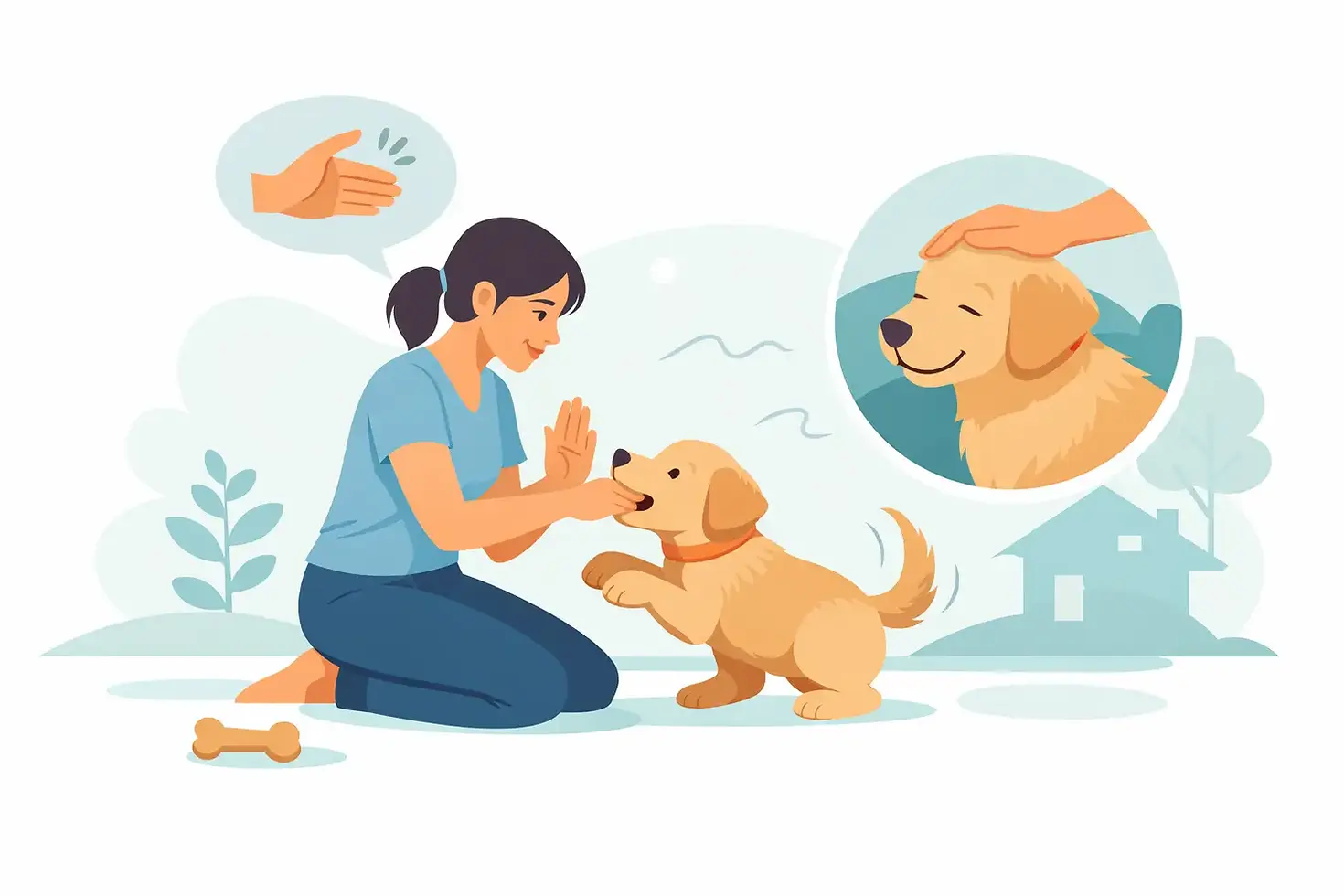
Teaching a hand target, often called “touch,” can be especially useful. Instead of reaching toward your puppy's face or collar when they are excited, ask them to touch their nose to your open hand and reward them. It gives you a simple way to redirect movement without grabbing at the puppy.
“Drop it” is also worth teaching early. Start with a low-value toy, offer a treat near the puppy's nose, and say the cue as they release the toy. Then give the toy back sometimes. This prevents the puppy from learning that people always take things away and makes it easier to handle stolen household items safely later.
Do not expect perfect self-control around every distraction right away. A puppy may know “sit” in the kitchen but forget it when visitors arrive or children start running. That is normal. Build skills gradually in the places where you actually need them.
Get the Whole Household Using the Same Rules
Mixed messages slow down progress. If one person allows hand wrestling, another squeals and runs away, and a third gives a toy, the puppy will keep testing each approach. Agree on one response: teeth on skin or clothing mean attention stops, then the puppy is redirected to an appropriate toy when calm.
Children need extra support because they move unpredictably and may not notice warning signs of rising excitement. Supervise closely. Give children safe ways to interact, such as tossing treats for a sit, helping with simple cue practice, or playing fetch in a clear space. Do not leave a child to manage a mouthy puppy alone.
Use gates, pens, lightweight house leashes under supervision, and separate rest areas when needed. Management is not failure. It prevents your puppy from rehearsing biting while they are still learning what you want instead.
When Puppy Biting Needs Individual Help
A normal puppy can still leave painful scratches and bruises, particularly with sharp baby teeth. But seek qualified, individualized behavior support if biting is frequent and escalating, breaks skin repeatedly, occurs around food or handling, or is paired with stiff posture, guarding, growling, freezing, or intense reactions to touch.
The setting matters. A puppy may bite only when being picked up, having paws handled, being approached near the food bowl, or meeting another pet. Those details change the training plan. Generic advice may not address what is happening in your home, with your routines and family members.
At CatDog Training, one-on-one coaching can focus on the real moments that trigger biting, from evening zoomies in the living room to leash grabbing at the front door. Practical help should show you what to do, let you practice it, and adapt the plan as your puppy grows - without locking you into a package before you know what support you need.
Your puppy is not trying to be difficult. They are learning the rules of a human household one interaction at a time. Be calm, be consistent, protect everyone from repeated rough play, and give them a better job for that busy little mouth.


Comments