
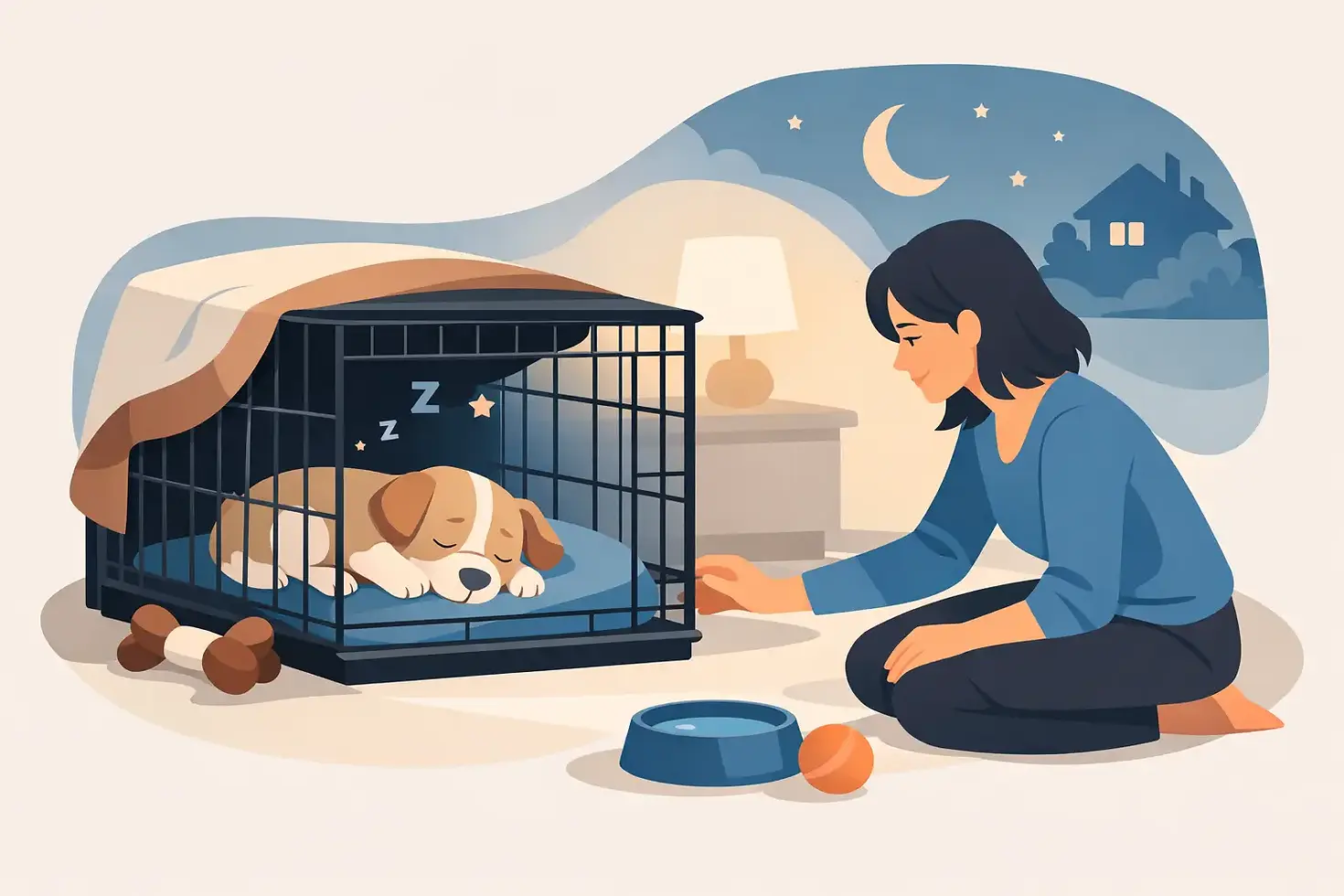
How to Crate Train Puppies Without Nightly Stress
A crate should not feel like a tiny jail sentence for a new puppy or a noisy source of stress for everyone trying to sleep. When people ask how to crate train puppies, the real goal is not to make a puppy tolerate a closed door. It is to teach them that this particular space is safe, predictable, and worth choosing.
That takes a little planning, especially in a busy household. A puppy who is overtired, under-exercised, frightened, or simply needs to toilet will not learn much from being left to cry in a crate. Good crate training is calm, gradual, and tied to the way your family actually lives.
Start With the Right Crate Setup
Choose a crate your puppy can stand up in, turn around in, and lie down comfortably in. It should not be so large that they can sleep at one end and regularly toilet at the other. For a growing puppy, a wire crate with a divider can be practical. A properly sized plastic travel crate can also work well for some dogs, particularly if they settle more easily in a den-like space.
Place it where your puppy can be near the household without being in the middle of constant activity. During the day, a quiet corner of the living area often works. At night, many young puppies settle better with the crate near the bed at first. You can move it gradually once they are sleeping comfortably, rather than expecting them to cope with isolation on their first night home.
Keep the setup simple. A safe mat or bedding may be appropriate if your puppy does not chew or shred it. If they do, remove loose items until they are more reliable. Avoid collars, harnesses, tags, or anything that could snag on crate bars when your puppy is unattended.
How to Crate Train Puppies Step by Step
The first sessions should happen when nobody is rushed. Leave the crate door open and toss a few pieces of your puppy's regular food inside. Let them investigate. Do not push, pull, or lure them so far in that they panic and rush back out. The puppy needs to feel that entering is their choice.
Once they are stepping inside comfortably, feed meals near the crate entrance, then just inside it. Over several meals, place the bowl farther back. This is not a test of willpower. If your puppy hesitates, move the bowl closer again and make the next attempt easier.
When your puppy is happily eating or relaxing inside, briefly close the door for a second or two, then open it before they become distressed. Offer a calm treat and let them come out if they wish. Build duration in small pieces: a few seconds, then half a minute, then a minute or two. Stay nearby at first.
The same approach applies when you begin stepping away. Close the door, take one step back, return, and open it while your puppy is still calm. Then try a few steps, briefly leave the room, and return. Small successes teach more than a long session that ends with frantic barking.
A food-stuffed toy or a safe chew can help create a positive association, but it is not a substitute for gradual training. Use items only when you know your puppy can handle them safely. Some puppies become so excited by food that they cannot settle, while others relax beautifully with a quiet chewing activity. Watch the dog in front of you, not a generic schedule online.
Close the Door Before You Need the Crate
A common mistake is using the crate only when you leave the house, need to answer a work call, or cannot supervise a puppy. Then the crate predicts separation and frustration. Build short crate sessions into normal daily life instead.
Ask your puppy to settle in the crate while you fold laundry nearby, make coffee, or sit down for ten minutes after a walk and toilet break. Open the door before they start demanding release. This helps the crate become an ordinary resting place, not an event that means the fun is over.
Build a Routine Around Toileting, Sleep, and Activity
Crates can support house training because most puppies prefer not to soil their sleeping space. But they do not give a puppy the physical ability to wait longer than their age, diet, stress level, or health allows. Expect frequent toilet breaks, particularly after waking, eating, drinking, playing, or training.
Before crate time, take your puppy out to their toilet area and give them enough time to finish. Keep that trip boring and clear. When they go in the right place, reward promptly. Then bring them inside for rest, supervision, or a short crate session.
Young puppies also need substantial sleep. A puppy who races around the house, bites harder, ignores familiar cues, and cannot settle may be overtired rather than badly behaved. A quiet crate break can help, but only after their basic needs have been met. Think toilet, water, age-appropriate activity, and a little calm connection first.
At night, very young puppies may need one or more scheduled toilet trips. If they wake and fuss, do not assume they are being difficult. Take them out quietly, keep lights and attention low, allow them to toilet, and return them to the crate without starting a play session. As their bladder control and routine improve, those trips can be reduced.
What to Do About Crying and Barking
Not every sound means the same thing. A brief protest after you close the crate door can be normal, especially during early training. Continuous, escalating distress is different. If your puppy is panting heavily, clawing, throwing themselves at the door, drooling, screaming, or unable to take food, the session has become too difficult.
Do not use a crate as a place to “cry it out” for long periods. That can teach a puppy that confinement is scary and that nobody responds when they are distressed. It can also create a bigger problem around being alone.
First, check the practical causes. Does the puppy need to toilet? Are they too hot, too cold, hungry, overstimulated, or in pain? Have they had any exercise or mental activity? If the basics are covered, reduce the challenge. Sit closer, shorten the duration, leave the door open during practice, or return to feeding inside the crate.
Try not to open the door at the exact peak of a demand bark if you can avoid it. Wait for even one quiet second, then calmly release or reward. But do not wait through a full panic episode to prove a point. Training should build confidence, not force endurance.
Avoid These Crate Training Setbacks
Crates are useful management tools, but they are not all-day containment. A puppy needs movement, toilet opportunities, social contact, training, and supervised time in the home. If your workday requires longer absences than your puppy can reasonably manage, arrange a realistic plan for breaks and care rather than expecting the crate to solve the problem.
Never send a puppy to the crate as punishment. If the crate follows yelling, scolding, or isolation after a mistake, it quickly loses its value as a safe place. For the same reason, do not use the crate to avoid teaching appropriate behavior elsewhere in the house. Chewing, jumping, nipping, and toileting need direct training and better management.
Be careful with timing around visitors and exciting activity. Some puppies settle in a covered crate during a family dinner; others feel more worried when they cannot see what is happening. Some prefer a crate in a quiet bedroom; others need to hear their people nearby. There is no prize for following a one-size-fits-all method.
When Personalized Help Makes Sense
Crate training can be more complicated when a puppy has separation distress, a history of being confined in a stressful setting, frequent accidents, nighttime panic, or a home with multiple pets and changing routines. In those cases, the right plan depends on the puppy's behavior, your layout, your work schedule, and how the household responds when problems happen.
One-on-one guidance can be especially useful because the details matter. A trainer can see where the crate is placed, how long the puppy is actually being left, what happens before the barking starts, and whether the issue is crate discomfort, overtiredness, separation concerns, or an unrealistic routine. CatDog Training works with families in their real home environments, where those answers are much easier to find.
Your puppy does not need to love the crate instantly. Give them repeated, manageable experiences of going in, resting safely, and coming back out without drama. A quiet puppy who walks into the crate on their own is not the result of a tougher method. It is usually the result of a fair routine and many small moments handled well.


Comments