
Puppy Schedule Example for Real Life at Home
- Gk Ang
- Aug 3
- 6 min read
A puppy does not need a military timetable. They need a predictable pattern that prevents the common problems owners call “bad behavior”: indoor accidents, biting during dinner, barking in the crate, or wild evening zoomies. This puppy schedule example gives you a workable day at home, then shows you how to adjust it for your puppy, your household, and the reality that no two days run exactly the same.
The goal is not to keep a puppy busy every minute. In fact, doing too much is often the reason a puppy becomes frantic and difficult to settle. A good schedule alternates toilet trips, short activity, meals, training, and plenty of protected rest. Consistency makes toilet training clearer, helps the puppy learn when to relax, and gives everyone in the home the same plan.
Start With the Needs Behind the Schedule
Young puppies need far more sleep than most first-time owners expect. Many need 18 to 20 hours of sleep across a full day. When a puppy has been awake too long, they may mouth hands, ignore cues they know, race around the room, or suddenly have an accident. That does not always mean they need another long walk. Very often, they need a quiet nap.
Toilet needs are also frequent and change quickly with age. Take a young puppy out immediately after waking, after eating or drinking, after active play, after time in the crate or pen, and before bed. Between those events, a very young puppy may need an opportunity to toilet every 30 to 60 minutes while awake. An older puppy can usually wait longer, but do not treat a calendar age as a guarantee.
Your puppy’s schedule should be built around their actual success. If accidents happen at 45 minutes, a one-hour interval is too long right now. If your puppy is sleeping peacefully in a safe setup, there is no reason to wake them just to follow the clock.
Puppy Schedule Example for an 8- to 12-Week-Old
This is an example for a household where someone is home for most of the day. It is not a demand that every family copy these exact times. Think in blocks and sequences rather than trying to run your home by the minute.
| Time | What happens | What to focus on | |---|---|---| | 6:30 a.m. | Wake up and toilet trip | Go straight outside or to the approved toilet area. Reward immediately after the puppy finishes. | | 6:45 a.m. | Breakfast | Feed calmly. Pick up the bowl after the meal if your vet has advised scheduled meals. | | 7:00 a.m. | Toilet trip, then 10 to 15 minutes of play or training | Practice name response, following a treat, gentle handling, or a simple recall indoors. | | 7:30 to 9:00 a.m. | Nap in crate, pen, or puppy-safe area | Keep the space quiet. A chew may help the puppy settle if appropriate and supervised. | | 9:00 a.m. | Toilet trip, short activity, then calm time | Let the puppy sniff, explore safely, and practice being near normal household activity. | | 10:00 to 11:30 a.m. | Nap | Most puppies need another rest period well before they look tired. | | 11:30 a.m. | Toilet trip and lunch | Many young puppies eat three meals daily. Follow your veterinarian’s feeding guidance. | | 12:00 p.m. | Toilet trip, short play, socialization exposure | Keep exposure positive and brief. This could mean hearing a vacuum at a distance, seeing traffic, or meeting one calm visitor. | | 12:30 to 2:30 p.m. | Nap | Prevent the afternoon overtired spiral before it starts. | | 2:30 p.m. | Toilet trip, training or play | A few minutes of leash practice, trading toys, or settling on a mat is enough. | | 3:00 to 4:30 p.m. | Rest or quiet independence practice | The puppy can be in a pen with a safe activity while you work nearby. | | 4:30 p.m. | Toilet trip and dinner | Keep the same post-meal toilet routine. | | 5:00 to 6:30 p.m. | Family time in short bursts | Supervise play, give toilet breaks, and avoid letting excitement build unchecked. | | 6:30 to 8:00 p.m. | Nap or quiet downtime | Many puppies need a reset before the evening household routine. | | 8:00 p.m. | Final gentle play, handling, and toilet trips | Keep things calmer as bedtime approaches. | | 10:00 p.m. | Last toilet trip and bed | Make the trip boring and businesslike, especially if the puppy wakes overnight. |
At this age, some puppies still need an overnight toilet break. If yours wakes and fusses, take them out quietly, give them a chance to toilet, and return them to bed without turning it into playtime. As bladder control develops, the overnight break usually fades naturally.
Do Not Mistake Exercise for a Solution
A puppy schedule needs activity, but nonstop activity is not good training. Long walks, repeated dog-park visits, and rough play with older dogs can overwhelm a young puppy physically and emotionally. They can also create a puppy who expects constant entertainment and struggles to settle in an ordinary home.
Short, age-appropriate outings are more useful. Let the puppy watch the neighborhood from a safe distance, walk on different surfaces, hear everyday sounds, and learn that passing people and dogs do not always mean a greeting. Socialization is about safe, positive exposure, not collecting as many interactions as possible.
Training can fit into the day without adding a separate hour. Ask for a sit before putting down a food bowl. Reward four paws on the floor before greeting someone. Practice coming when called from one room away. Give a chew in the pen while you make coffee. These small repetitions are easier for a puppy to understand than one long session after they are already tired.
Adjust the Schedule for Workdays and Busy Homes
The hard truth is that an 8-week-old puppy cannot usually handle a full workday alone. A crate is a useful training and safety tool, not a place to store a puppy for eight or nine hours. If everyone is away, arrange a responsible visitor, pet-care support, or a carefully managed toilet area and confinement setup that suits the puppy’s age and needs.
For owners who work from home, the opposite problem is common: the puppy never learns to be alone. Build short independence periods into the schedule. Start with the puppy resting in a pen while you sit nearby, then gradually create small, successful separations. Do not wait until the first day you must leave for several hours to discover that your puppy panics when a door closes.
In a busy household, assign responsibility clearly. One person may handle the morning meal, another the late-afternoon toilet break, but everyone should use the same toilet location, reward system, and house rules. Mixed messages slow learning. If one person allows jumping on the couch and another scolds it, the puppy is not being stubborn. The puppy is receiving two different lessons.
How to Know the Routine Is Working
A useful routine produces more than fewer accidents. You should see a puppy who settles more easily, has predictable toilet opportunities, recovers after excitement, and can spend brief periods calmly apart from you. There will still be accidents, especially during growth spurts, visitors, storms, illness, and changes in routine. That is normal.
When an accident happens, clean it thoroughly and review the few minutes before it. Did the puppy wake up? Finish a meal? Play hard? Have access to too much space? The answer usually points to a management change, not a need for punishment. Scolding after the fact only teaches a puppy to avoid toileting in front of you.
If your puppy repeatedly soils their crate, cries for long periods when confined, cannot settle, or seems unable to hold urine even with frequent trips, get practical help early and speak with your veterinarian when health may be involved. A personalized plan is especially useful when your home has children, cats, another dog, limited outdoor access, or conflicting schedules.
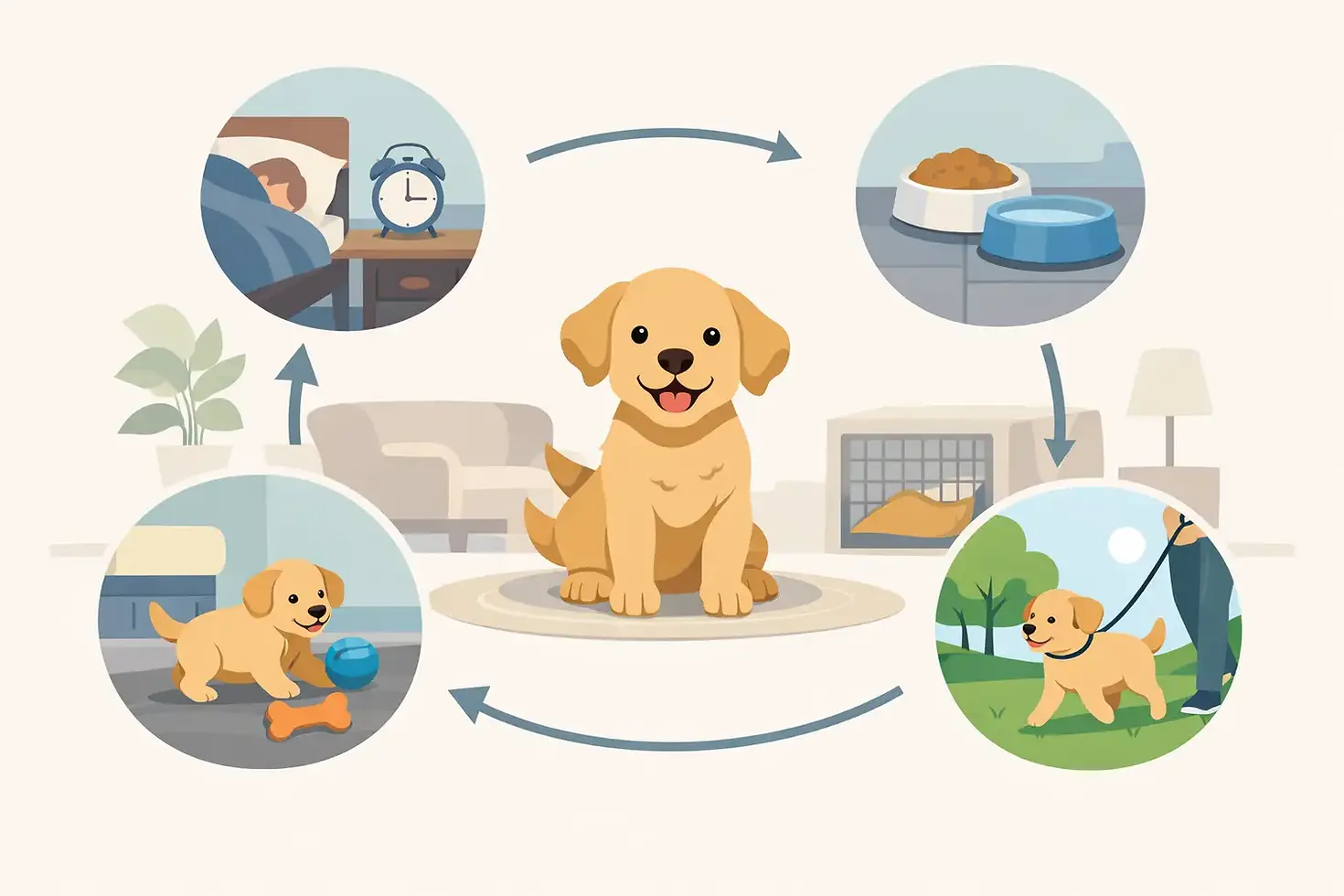
Keep the routine simple enough that you can follow it on an ordinary Tuesday. Your puppy will not remember whether breakfast was at 6:30 or 6:45. They will learn from the steady pattern: wake up, toilet, eat, play a little, rest a lot, and return to the right place before they need to go.


Comments