
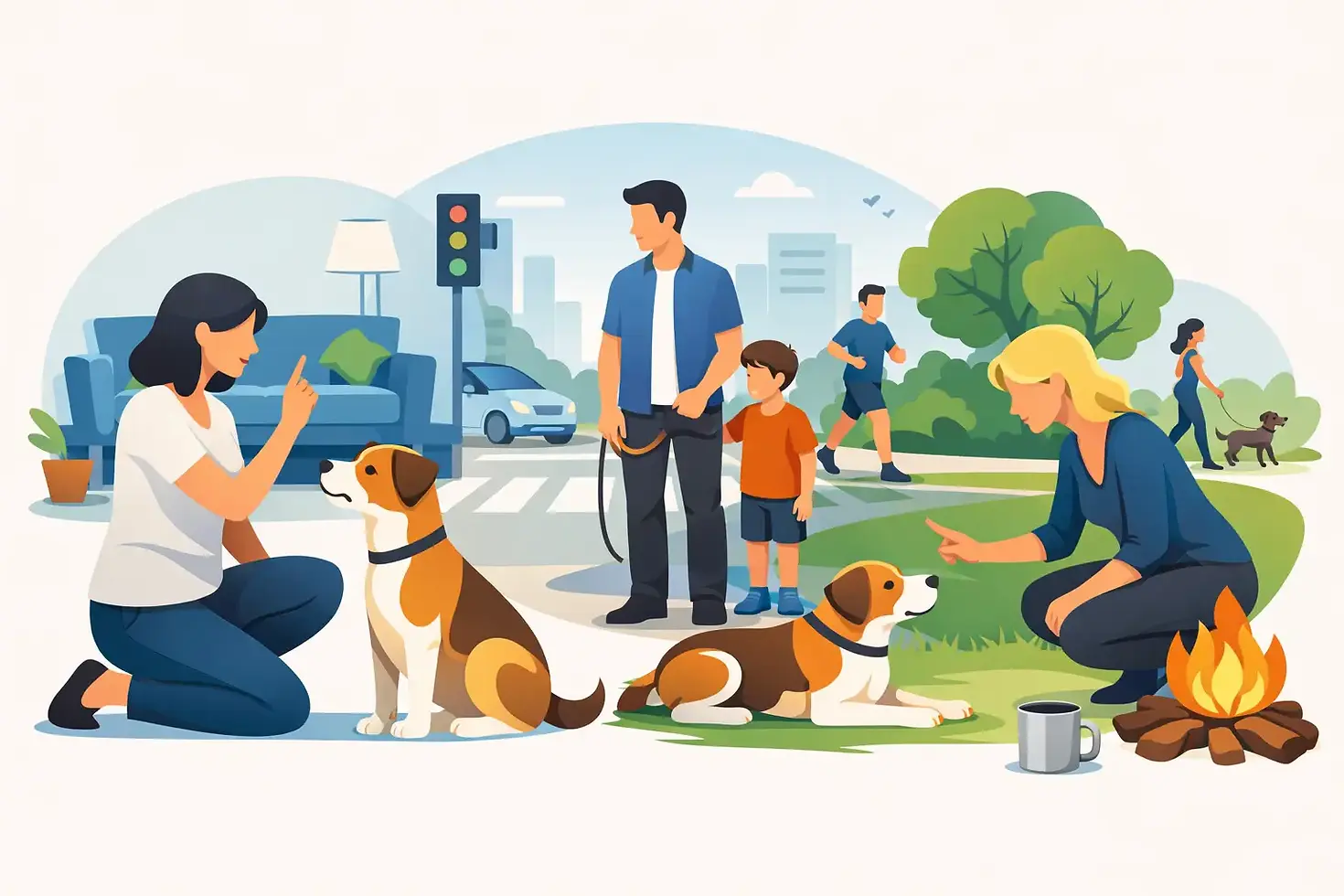
Dog Obedience That Works Where Life Happens
The real test of dog obedience is not whether your dog can sit for a treat in a quiet room. It is whether they can pause at the front door, walk past another dog without dragging you down the sidewalk, settle while dinner is cooked, and come back when something interesting catches their attention. Those are the moments that shape daily life with a dog.
Good training should make home life easier, safer, and less stressful. It should not leave you with a long list of commands your dog only performs when a trainer is holding food. The goal is a dog that understands what to do in the situations your household faces every day.
What Dog Obedience Should Actually Solve
Obedience is often presented as a fixed set of cues: sit, stay, down, come, heel. Those skills are useful, but they are not the whole picture. A polite sit does not solve a dog that bolts through the door. A perfect down in the living room does not automatically help when visitors arrive, a delivery person rings the bell, or a squirrel appears during a walk.
Practical obedience connects cues to real behavior. It teaches your dog how to respond when excitement, fear, frustration, or distraction is involved. It also teaches owners how to give clear instructions, reward the right choices, and prevent unwanted habits from becoming rehearsed.
For one household, the priority may be loose-leash walking. For another, it may be stopping counter surfing, barking at hallway sounds, jumping on children, or calmly sharing space with another pet. There is no honest one-size-fits-all plan because the problem, the dog, and the home are not the same.
The basics are only useful when they transfer
A cue is not finished just because your dog can do it once. Dogs learn in context. A dog may understand “come” in the kitchen but struggle to respond at the park, near another dog, or when guests are present. That does not mean the dog is stubborn. It means the skill needs to be built gradually in the environment where it will be needed.
This is why real-world practice matters. Training at the doorway, on your normal walking route, around your family’s routines, and in the rooms where problems happen gives both dog and owner useful repetition. It replaces guesswork with a clear plan.
Start With Management, Not Repeated Commands
Many obedience problems get worse because the dog has too many chances to practice the unwanted behavior. If a dog rushes the door ten times a week, pulls for an entire walk, or gets rewarded by attention every time they jump, the habit becomes stronger. Repeating “no” or saying a cue louder rarely fixes that pattern.
Management is the practical first step. Use a leash at the door while training greetings. Keep tempting food off accessible counters. Set up a quiet resting area when the house is busy. Choose walking routes and distances your dog can handle while you build better leash skills. These are not shortcuts or signs of failure. They prevent chaos while your training starts to take hold.
Management should support training, not replace it. The next step is showing the dog what earns access to the things they want: going outside, greeting a person, moving forward on a walk, receiving attention, or getting a treat. When the dog learns that calm behavior works, obedience becomes more useful than conflict.
Build Skills in the Right Order
Reliable behavior is usually built in small stages. Asking for too much too soon can make a dog ignore cues, get frustrated, or lose confidence. A young puppy, an adolescent dog with endless energy, and an adult rescue dog adjusting to a new home may all need different starting points.
First, teach the behavior in a low-distraction setting where success is likely. Then add small challenges: a family member walking through the room, a door opening, a toy nearby, or a few extra seconds of waiting. After that, practice in more difficult places. Increase only one challenge at a time, such as distance, duration, or distraction.
For example, a recall should begin close by, with a reward your dog truly values. Once your dog turns toward you quickly and happily indoors, practice in a fenced area or on a long line. Calling a dog away from a major distraction before the skill is ready can teach them that “come” is optional. It is better to protect the cue and build it properly.
The same principle applies to leash walking. Before expecting a dog to pass every person and dog calmly, help them learn how to check in with you, turn with you, and settle after seeing something exciting. A walk is not just exercise. It is a series of decisions, and your dog needs support making better ones.
Clear Timing Matters More Than Fancy Techniques
Owners are often given complicated advice when what they need is clearer timing. Your dog needs to understand exactly which behavior earned the reward or ended the opportunity. If you reward after the jumping has already started, or allow pulling to reach the destination, the message becomes mixed.
Mark and reward the moment your dog makes the right choice. That may be four paws on the floor when a guest enters, a loose leash before moving forward, or a glance back at you after noticing another dog. Small, well-timed rewards help the dog understand faster than long lectures after the fact.
Rewards do not have to mean treats forever. Food is often useful when teaching a new skill because it is clear and efficient. Later, real-life rewards can do a lot of the work. A calm dog gets to go through the door. A dog who walks on a loose leash gets to continue sniffing. A dog who settles politely gets attention from the family.
What motivates one dog may not motivate another. Some dogs work enthusiastically for food, while others care more about a ball, praise, movement, or access to the environment. Effective training pays attention to the individual dog instead of insisting that every dog should respond to the same method.
Why Household Training Needs the Whole Household
A dog cannot follow one rule with one person and a different rule with everyone else without becoming confused. If one person allows jumping, another pushes the dog off, and a third gives attention only when the dog is calm, the dog is left to figure out which version applies. That slows progress.
Household training does not require everyone to become a professional trainer. It does require agreement on a few practical rules. Decide what happens at the door, how walks begin, where the dog rests during meals, and what family members should do when the dog seeks attention. Keep the language simple and the expectations realistic.
Children should have safe, age-appropriate roles rather than being asked to handle difficult behavior. They can reward calm behavior, help with simple cues under supervision, or participate in structured games. Adults should manage situations involving jumping, guarding, pulling, or fear until the dog has the skills to cope safely.
Consistency matters, but perfection is not required. A missed training moment will not ruin your dog. What matters is returning to the plan often enough that the desired behavior becomes the dog’s normal habit.
When Obedience Is Really a Behavior Concern
Not every issue labeled “disobedience” is an obedience issue. A dog who will not approach strangers may be fearful. A dog that explodes on leash may be overwhelmed, frustrated, or reactive. A dog that suddenly starts having accidents indoors could have a health concern. Treating these problems as simple defiance can make them worse.
Behavior modification may include obedience skills, but it also requires a closer look at triggers, stress signals, routines, health, and safety. The plan may need more distance from triggers, slower exposure, environmental changes, or a veterinarian’s input. Progress can be less linear than teaching sit or stay, but it is still possible with a thoughtful approach.
This is where individualized support has real value. A trainer who sees your dog in the actual problem setting can assess what happens before, during, and after the behavior. That is much more useful than trying to copy a generic exercise that may not fit your dog or your home.
Make Training Part of Ordinary Life
You do not need hour-long drills every day. Short practice built into normal routines is often more effective. Ask for a pause before meals, a sit before clipping on the leash, a check-in before crossing the street, or a settle while you answer the door. These moments add up.
Keep sessions short enough that both you and your dog can succeed. End while the dog is still engaged. If a day is busy, use one good repetition rather than skipping training completely or trying to force a long session when everyone is tired.
At CatDog Training, the focus is on practical, one-on-one coaching in the places behavior actually happens. That means working with your dog, your routine, and your household goals rather than selling a preset package that may not address the problem.
A well-trained dog is not a silent robot, and obedience is not about winning a battle of wills. It is about giving your dog clear information, fair boundaries, and enough practice to make good choices feel familiar. Start with the situation that causes the most stress at home, make the next step manageable, and let steady progress change the way daily life feels.


Comments