
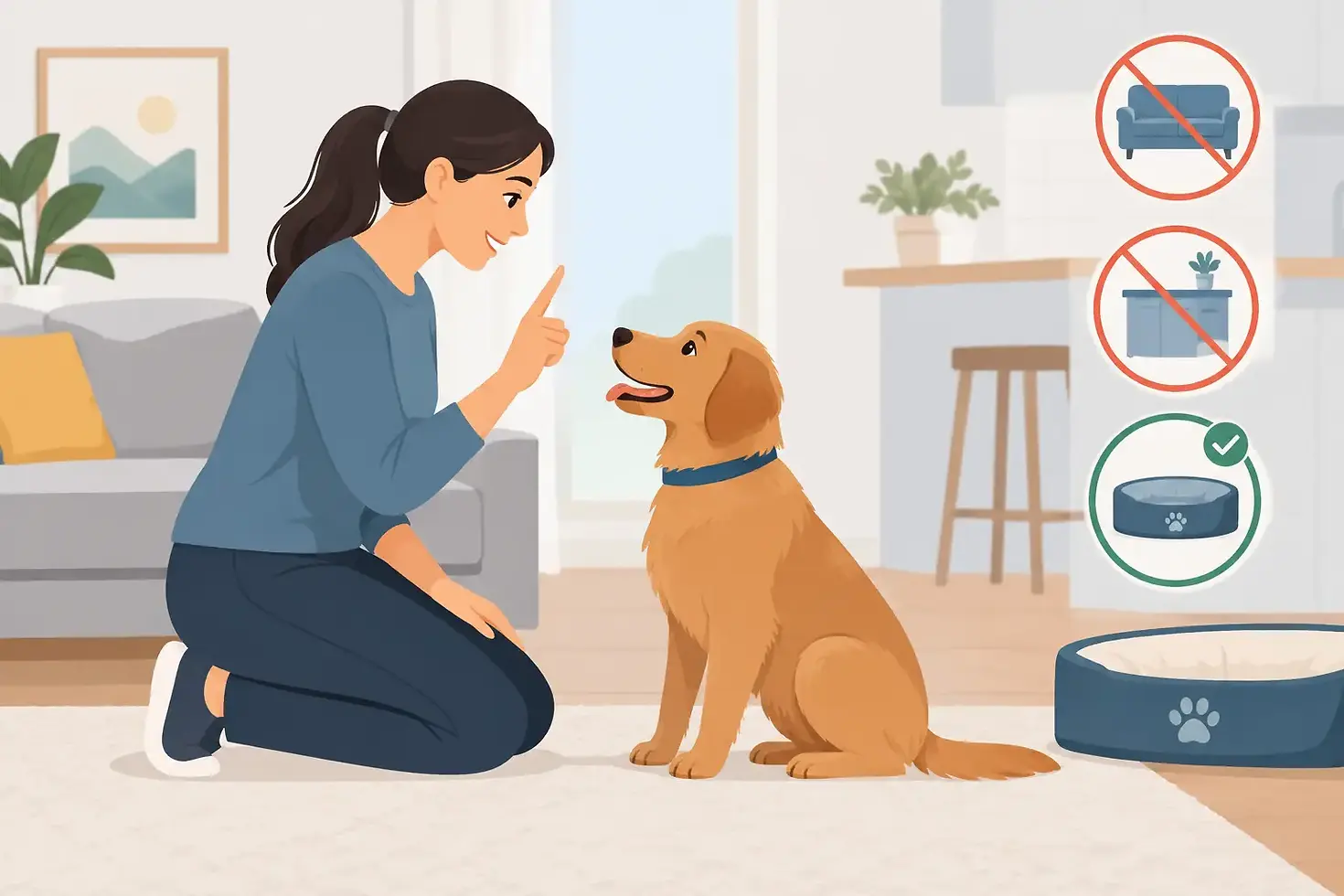
Can Dogs Learn Household Rules? Yes, With Practice
A dog who jumps on the couch only when one family member is home is not being stubborn or trying to “get away with it.” He has learned that the rule changes depending on the person, the timing, or what happens next. So, can dogs learn household rules? Absolutely. But they learn rules through repeated experience, not through a single correction or a word they have never been taught to understand.
Household rules can be simple: wait before going out the front door, stay off the dining chairs, toilet outdoors, settle while people eat, or greet visitors with four paws on the floor. They can also be more specific to your home, such as not rushing the cat, leaving a child’s toys alone, or walking calmly through an apartment hallway. The most reliable results come when the rule is clear, everyone applies it similarly, and the dog gets practice in the exact situation where the problem occurs.
Can Dogs Learn Household Rules in Any Home?
Yes, including busy homes, small apartments, multi-pet homes, and homes with children. The setup may change, but the learning process is the same. Dogs notice patterns. They learn what leads to access, attention, food, play, a walk, or a closed door.
That is why real-life training matters. A dog may sit beautifully in a quiet room, then ignore the cue when the doorbell rings. He has not necessarily forgotten the behavior. The distraction level, excitement, and payoff have changed. Training needs to account for those details instead of assuming a dog who understands a cue in one place will automatically follow it everywhere.
Age is not a barrier. Puppies often learn routines quickly because everything is new, while adult and senior dogs can learn new expectations as well. An older dog may need a more gradual plan if a long-standing habit has been rewarded for years. A dog with pain, hearing loss, anxiety, or a sudden behavior change should also be assessed carefully. Training is not a substitute for veterinary care when a medical issue may be involved.
A Rule Is Only Clear When the Dog Can Succeed
People often say, “My dog knows better.” Sometimes that is true. More often, the dog knows part of the rule, in part of the situation, with part of the family.
Take the couch rule. “Off” can mean several different things to a dog: get off when told, never get on, stay off only when guests are present, or get off the moment a particular person walks in. Those are different rules. Before expecting consistency, decide what you actually want.
Then make the right choice easy. If the dog is allowed on one blanket but not the furniture itself, use the same blanket every time. If he should rest on a bed while the family eats, place that bed near the table at first and reward calm behavior there. If he should not enter the kitchen, a gate or closed door prevents him from rehearsing the opposite behavior while you teach the boundary.
Management is not cheating. It protects the new habit while it is still fragile. Repeatedly letting a dog practice the behavior you do not want, then correcting him after the fact, is slower and less fair than setting up a clear path to success.
Teach the Action, Not Just the Prohibition
Dogs generally do better when they are shown what to do instead. “Don’t jump” becomes “keep four paws on the floor” or “go to your mat when visitors arrive.” “Don’t bark at the window” may become “come away from the window and settle on your bed.”
Start in an easy version of the situation. For door manners, practice with a family member approaching the door before working with an actual delivery person or excited guests. Ask for a sit, wait, or mat behavior. Reward the response you want, then gradually add more realistic distractions.
Timing matters. Rewarding the dog after he has jumped, barked, or rushed through the door can accidentally strengthen the very behavior you are trying to reduce. The reward should arrive while he is making the better choice, even if that choice is only a brief pause at first.
Food rewards can be useful, especially while teaching a new skill, but they are not the only option. Access to the yard, a tossed toy, greeting a person, or being invited onto a bed can all be rewards if the dog values them. The best reward depends on the dog and the situation. A dog who is highly excited by visitors may care more about getting to say hello than about a treat.
Consistency Does Not Mean Being Harsh
A clear household rule should be predictable, not intimidating. Dogs do not need shouting, physical punishment, or confusing confrontations to learn boundaries. Those methods can make some dogs anxious, defensive, or less willing to offer behavior around people.
Consistency means the response is dependable. If the dog jumps up for attention, nobody gives attention while he is jumping. When his paws return to the floor, he gets the greeting. If the dog must wait before leaving the elevator, the same short routine happens each time. Calm repetition teaches more than a dramatic response that changes from day to day.
That does not mean every family member must train with identical words or perfect timing from day one. Real households are not training facilities. The goal is to agree on the key rule, the cue if one is needed, and the response when the dog gets it right or makes a mistake.
Why Dogs Follow One Person but Not Another
This is one of the most common household frustrations. A dog may walk politely for one owner and pull for another, or wait at the door for an adult but charge ahead with a teenager.
Dogs are excellent at reading context. They recognize different voices, body language, walking speed, leash handling, and patterns of follow-through. If one person says “wait” and opens the door anyway when the dog pushes forward, that person has taught a different lesson from the family member who calmly resets and tries again.
The answer is not to blame the less experienced handler. It is to give that person a simple routine they can realistically repeat. A complicated plan is unlikely to survive the morning rush, a tired evening, or a child trying to get out the door for school.
For homes with several people, it helps to choose a few priority rules first. Trying to fix jumping, pulling, barking, counter surfing, toileting accidents, and visitor behavior all at once can leave everyone frustrated. Start with the behavior that affects safety, stress, or daily life most. Progress in one area often makes the rest easier.
Practice Where the Rule Will Be Used
A dog does not automatically understand that “leave it” applies to dropped food, the cat’s bowl, a shoe, and something found on a walk. Generalizing a rule takes practice across places and situations.
This is why in-home coaching can be especially useful for household behavior. The trainer can see the actual entryway, furniture arrangement, feeding setup, hallway traffic, other pets, and daily routine. The plan can fit the dog you have and the home you live in, rather than asking you to copy a generic exercise that does not match the problem.
For example, a dog who barks at noises outside an apartment door may need a different plan than a dog who reacts to people passing a front window. Both may be described as barking, but the triggers, layout, and management options are different. The same applies to toilet training, multi-pet introductions, leash behavior, and rules around children.
At CatDog Training, one-on-one sessions are built around these real conditions. There is no need to commit to a prepaid package before you know what your dog needs. A practical plan should be clear, adjustable, and useful between sessions.
When a Household Rule Is Not Working
If you have repeated the same rule for weeks with little change, look at the setup before assuming the dog is refusing to learn. Is the expectation specific? Does everyone respond the same way? Is the dog being rewarded for the unwanted behavior somewhere else? Is the task too hard for his current level of excitement or stress?
Sometimes the rule itself needs adjustment. Expecting a young, energetic dog to lie still through a two-hour dinner party may not be realistic without preparation, exercise, breaks, and a quiet place to rest. Asking for a short settle while the family eats is a more achievable starting point. Good training works with the dog in front of you, not an idealized version of one.
The goal is not a dog who looks perfect for visitors. It is a dog who understands how to live safely and comfortably with the people around him. Clear rules, patient repetition, and a plan that fits your actual home give him the best chance to get there.


Comments